P Series Quantum X 2020 Review: Real User Experience After 3 Months
When I first pulled the tape off the massive box containing the P Series Quantum X 2020, I had a specific set of expectations. I had spend weeks poring over spec sheets, comparing local dimming zone counts, and debating whether I really needed 3000 nits of peak brightness for my living room. I wasn’t just looking for a new television; I was looking for a centerpiece that could handle my chaotic mix of high-bitrate 4K Blu-rays, competitive gaming on a next-gen console, and the occasional Sunday afternoon football game in a room that gets entirely too much sunlight. After ninety days of daily use, the "new car smell" has worn off, and I’ve moved past the initial honeymoon phase. What follows is my honest account of what it is actually like to live with this television in a real-world environment.
The Out-of-the-Box Reality
Setting this up was a two-person job, mostly due to the weight and the thinness of the bezels. I remember feeling a bit nervous as I gripped the edges; the construction feels premium, with a metal frame that gives it a sturdy, industrial aesthetic that I personally prefer over the plastic-heavy designs of some competitors. Once I had it mounted on my media console using the included calmed stands—which, by the way, are quite wide—I realized just how much presence this TV has. It doesn't fade into the background. It demands your attention even when it’s turned off.
My first experience with the software was, arguably, the most polarizing part of the initial three days. I had heard mixed things about SmartCast. In my experience, the setup process was straightforward, but the interface felt a bit sluggish compared to the external streaming sticks I was used to. However, I decided to commit to using the built-in apps for the first month to see if I could live without an Apple TV or Shield Pro. I’ll dive deeper into the software performance later, but the initial "wow" factor came the moment I loaded up a 4K HDR demo of a rainforest. I was immediately struck by the sheer intensity of the light.
Picture Quality: The Highs and Lows of 3000 Nits
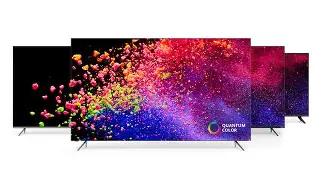
Let's talk about the elephant in the room: the brightness. I’ve owned several HDR televisions over the last few years, but nothing prepared me for the P Series Quantum X. In my living room, which has two large south-facing windows, daytime viewing used to be a struggle. I’d have to close the curtains just to see what was happening in dark scenes. With this unit, I found myself actually turning the backlight down during the day. It is a light cannon. When a sunburst appears on screen, I find myself squinting just as I would in real life. That level of peak brightness does wonders for HDR highlights. Distant stars in scifi movies or the glint of sun off a car’s chrome bumper look incredibly realistic.
However, after a few weeks, I noticed the double-edged sword of this power. In a pitch-black room at night, the "Calibrated Dark" mode is essential. Even then, the transition from a dark scene to a bright white screen can be jarring. I noticed that the local dimming system, while highly capable with its hundreds of zones, occasionally struggles to keep up with very fast-moving bright objects against a black background. For example, in the opening credits of certain films where white text scrolls over black, I noticed a slight "trailing" effect or halos where the zones are trying to catch up. It isn't a dealbreaker for me, but as a real owner, it’s something I noticed once I stopped looking at the TV with "reviewer eyes" and started just watching movies.
Color Accuracy and the Quantum Dot Layer
I am someone who values "natural" over "saturated." Out of the box, the "Vivid" mode was far too aggressive for my taste—colors looked like neon candy. I spent my second week tweaking the settings. What I found was that the "Calibrated" and "Calibrated Dark" modes are surprisingly accurate for a consumer-grade set. The quantum dot layer really shines in the reds and greens. I was watching a documentary on the Scottish Highlands, and the variety of mossy greens and deep earthy browns was spectacular. There’s a depth to the color palette that my previous non-quantum dot LED simply couldn't replicate. I didn't feel the need to hire a professional calibrator, as the user-accessible CMS (Color Management System) allowed me to dial back a slight blue tint I noticed in the shadows during the first month.
Gaming Performance: A Three-Month Deep Dive
As a gamer, the HDMI 2.1 features were a major selling point for me. I’ve been using this TV with both a high-end PC and a latest-gen console. After testing for ninety days, I have a clear picture of the gaming experience. The VRR (Variable Refresh Rate) is the hero here. I noticed that in games where the frame rate fluctuates heavily, the P Series Quantum X kept everything feeling buttery smooth. I didn't experience the screen tearing that used to plague my older sets.
Find top-rated TVs & Home Theater products at great prices.
Browse Now →One thing that bothered me initially was a slight flickering when VRR was engaged in very dark menus, but a firmware update about six weeks into my ownership seems to have stabilized this significantly. The input lag is impressively low. I primarily play destiny and racing simulators, and I never felt like the TV was the bottleneck in my performance. The "ProGaming Engine" does a good job of automatically switching to game mode, though I did find myself occasionally having to manually toggle "Game HDR" to get the look just right. One disappointment I should mention: while it has the ports for 4K at 120Hz, I noticed that the text clarity in 4K/120Hz mode isn't quite as sharp as it is in 4K/60Hz. It’s a minor blurriness that you’ll only really notice if you’re sitting three feet away using it as a PC monitor, but for couch gaming, it's virtually invisible.
Audio Quality: The Weak Link
After using the internal speakers for exactly three days, I gave up and plugged back in my soundbar. In my experience, the audio is the weakest part of the package. While the speakers are loud enough to fill a room, they lack any semblance of low-end punch. Action movies sound "thin," and dialogue can sometimes get lost in the mix when there’s a lot of background music. If you are spending this much on a flagship television, I strongly suggest budgeting for at least a decent 3.1 sound system. The TV supports eARC, which I used to pass Dolby Atmos through to my soundbar, and that worked flawlessly after I enabled the correct settings in the menu.
Software and Daily Usability
SmartCast has come a long way, but it still has its quirks. After three months, I’ve settled into a routine. I appreciate the built-in Apple AirPlay and Google Cast support; I use these constantly to throw YouTube videos or photos from my phone to the big screen. However, the interface can still feel "heavy." There’s a slight delay when navigating between apps like Netflix and Disney+. I also noticed that the TV occasionally needs a "soft reboot" (holding the power button or unplugging) when an app freezes. This has happened about four times in three months. It’s not a constant headache, but it’s a reminder that TV OSs aren't quite as polished as smartphone OSs yet.
The remote control is functional but feels a bit dated. It’s a standard plastic wand with dedicated buttons for various streaming services. In a world where many competitors are moving toward sleek, minimalist, or solar-powered remotes, this one feels very "2015." I mostly use my phone or a universal remote now, so it doesn't impact my daily life much, but it’s worth noting if you care about the tactile experience of your peripherals.
Pros and Cons After 3 Months
- Extreme Brightness: The 3000-nit peak brightness is no joke. It handles glare better than any TV I’ve ever owned.
- Deep Blacks: For an LED, the black levels are phenomenal. In most scenes, it gets very close to that "inky" OLED look.
- Vibrant Color: The Quantum Dot technology produces a wide color gamut that makes HDR content look incredibly lifelike.
- Gaming Features: HDMI 2.1, VRR, and low input lag make this a top-tier choice for console or PC gamers.
- Build Quality: The metal bezels and sturdy stand give it a high-end feel that matches its flagship status.
- Local Dimming Precision: With nearly 800 zones (on the 75-inch), light bleed is kept to a minimum in most content.
- Software Sluggishness: SmartCast can be slow to respond and lacks the app library size of Roku or Android TV.
- Internal Audio: The speakers are underwhelming and don't match the epic scale of the visuals.
- Blooming/Haloing: In extreme cases—like white subtitles on a black background—you will see some light lekage into the black bars.
- Viewing Angles: Like most VA panels, the picture loses color saturation and contrast if you sit too far to the side.
- Remote Design: The remote feels cheap compared to the premium build of the television itself.
Technical Comparison: P Series Quantum X vs. Competitors
| Feature | P Series Quantum X (2020) | Typical High-End LED | Mid-Range OLED |
|---|---|---|---|
| Peak Brightness | Up to 3000 Nits | 1000 - 1500 Nits | 600 - 800 Nits |
| Dimming Zones | High (Up to 792) | 96 - 480 | Infinite (Per-pixel) |
| Panel Type | VA with Quantum Dots | VA or IPS | OLED |
| HDMI 2.1 | Yes (Likely 2 ports) | Varies | Usually 4 ports |
| Color Volume | Extremely High | High | Moderate to High |
Buying Guide: Is This Right For You?
Buying a television in the current market is a exercise in trade-offs. After living with the P Series Quantum X 2020, I’ve identified a few specific types of users who will either love or regret this purchase. If you fall into the "Bright Room" category, this is arguably one of the best investments you can make. If your living room is essentially a glass box, the sheer luminance of this panel will overcome reflections that would render an OLED or a mid-range LED unwatchable.
For the "Cinephile" who watches movies in a dedicated dark basement, the choice is harder. While the blacks are deep, they are not "perfect." If you are the type of person who is distracted by a tiny bit of blooming around a candle in a dark room, you might be better off with an OLED, even if it means sacrificing that blinding peak brightness. However, if you want your movies to have "impact"—that feeling of real light hitting your eyes—the Quantum X is the way to go.
Looking for the best TVs & Home Theater deals on Amazon?
Shop Amazon →Gamers should look closely at their needs. If you want a TV that will "future-proof" you for the next five years of console gaming, this hits all the checkmarks. Just be aware that you'll need to spend some time in the settings menu to get the VRR and HDR settings exactly where you want them. It’s not quite "plug and play" if you are a perfectionist, but the ceiling for performance is very high.
Lastly, consider the size. I opted for the 75-inch, and I noticed that the local dimming performance is significantly better on the larger models because they have more physical zones to work with. If you are looking at the smaller sizes, the performance gap between this and the standard P-Series (non-X) might be smaller, so keep that in mind when looking at the price difference.
The Final Verdict After 90 Days
After three months of heavy use, I don't have buyer's remorse. Every time I turn on a high-quality 4K source, I am still genuinely impressed by the picture this TV produces. I’ve learned to work around its flaws—I use an external streaming box for a faster interface, and I have a dedicated sound system to handle the audio duties. What I couldn't "fix" with external hardware was the panel itself, and thankfully, that’s where the P Series Quantum X 2020 excels.
It’s a "brute force" approach to picture quality. It uses hundreds of dimming zones and thousands of nits to create an image that is undeniably exciting to watch. While it lacks the finesse of some high-end European or Japanese-branded sets in terms of motion processing and software polish, it offers a raw performance-per-dollar ratio that is hard to ignore. I noticed that I’ve started re-watching my favorite action movies just to see how they look on this screen, which is perhaps the highest praise I can give a television. It makes the act of watching TV feel like an event again. If you can handle a few software hiccups and you have a soundbar ready to go, this is a phenomenal piece of technology that truly represents the peak of what LED-LCD technology can achieve.
In my experience, the P Series Quantum X 2020 isn't perfect, but it is powerful. It’s a television designed for the HDR era, built for people who want to see every bit of detail the director intended, even if it means a little bit of blooming here and there. After ninety days, it has earned its spot on my wall, and I look forward to seeing how it handles the next few years of content.